For years, the travel industry has debated commission splits as though advisors face a fundamental choice between independence and support.
Keep 100% of your commission, the argument goes, and you’re largely on your own. Give up a meaningful percentage of it, and in return you’ll receive the technology, marketing, accounting, systems and support necessary to grow.
After nearly four decades of owning and operating a travel agency, I don’t believe advisors should have to make that choice.
Why can’t they have both?
At Oasis Travel Network, we have built our business around a simple premise: a successful travel advisor already creates meaningful economic value for the organization supporting them.
Their production contributes to supplier relationships, preferred agreements, marketing opportunities and other revenue available to a host agency. At sufficient scale, those economics can be substantial.
Our philosophy has always been simple:
Before asking the advisor to give up more of what they’ve earned, we should first build an efficient business around the revenue their production already generates.
That’s what we’ve done.
100% Commission Doesn’t Have to Mean 100% on Your Own
There is absolutely a cost to supporting a successful independent advisor.
They need commissions processed accurately and quickly. They need knowledgeable people who can intervene when there is a supplier problem. They need marketing resources. They need technology, accounting support, education, preferred-supplier relationships and opportunities to connect with their peers.
As their businesses grow, some will need help building teams and creating systems that allow them to scale beyond their own individual capacity.
None of that is free.
But somewhere along the way, our industry began treating the commission split, and increasingly, layers of additional fees, as though they were the only ways to pay for those things.
They aren’t.
Scale matters. Efficiency matters. Supplier economics matter. Technology choices matter. Organizational structure matters.
A host agency doesn’t necessarily need to build proprietary technology when excellent technology already exists. It doesn’t need to recreate marketing platforms and resources that industry partners already provide. And it doesn’t need layers of infrastructure simply because that’s how the business has traditionally operated.
Every dollar of unnecessary overhead eventually has to come from somewhere.
Our approach has been to keep the organization efficient and put as much of the economics as possible back where we believe it belongs: with the advisor who generated the business.
The Advisor Is Already Creating Value
This is where I think our industry sometimes gets the economics backward.
A productive advisor shouldn’t simply be viewed as a customer from whom a host needs to generate more fees.
That advisor is already creating tremendous value.
Their production strengthens supplier relationships. It increases collective buying power. It creates marketing opportunities. It improves the economics of the entire network.
And as the collective production of the network grows, those advantages become increasingly powerful.
It’s a very simple flywheel:
The advisor succeeds. The network becomes stronger. The network’s strength creates more opportunities for the advisor.
The host succeeds because its advisors succeed.
That’s alignment.
And it has allowed us to build a profitable business in which productive advisors can retain 100% of their commissions while paying minimal fees, and in some cases effectively paying no fees at all.
Success Should Improve the Economics
There is another assumption I think deserves examination.
Why should an advisor’s economics necessarily become less attractive as the advisor becomes more successful?
As entrepreneurs grow, we normally expect scale to work in their favor.
An experienced advisor producing several million dollars annually is often more self-sufficient than someone just entering the industry. They know their suppliers. They have established clients. They understand their systems. They know how to resolve routine problems.
Of course they still need their host.
When something goes wrong, they need someone who answers the phone. They need advocacy with suppliers. They need accurate and timely commission payments. They need access to strong preferred relationships, marketing, education and a professional community.
But greater production doesn’t automatically mean proportionately greater demands on the host.
In many cases, quite the opposite is true.
That raises a reasonable question for every successful advisor:
As my business grows, are the economics of my host relationship improving along with it?
I think that’s a question every entrepreneur should periodically ask.
Growth Doesn’t Have to Mean Giving Up Independence
Can a successful independent advisor eventually become overwhelmed by growth?
Absolutely.
But that’s a business-management challenge, not necessarily a commission-model problem.
Hire an assistant. Build a team. Outsource certain functions. Adopt better technology. Create processes. Delegate administrative work.
Those are investments in the advisor’s own business.
And that’s an important distinction.
The advisor owns the benefit of those investments.
As entrepreneurs grow, the objective should be to create operating leverage, allowing the business to become more efficient as it becomes larger.
A host should be part of that equation.
It should help remove obstacles to growth, not become an increasingly expensive consequence of growth.
Forty Years Has Taught Me Something Simple
I’ve owned a travel agency through nearly every major change this industry has experienced over the past four decades.
Airline commission cuts. The rise of the Internet. Supplier consolidation. Online travel agencies. Host agencies. Consortia. Home-based advisors. Social media. New generations of technology and, today, artificial intelligence.
Every few years, we’re told that something needs to be reinvented.
Sometimes it does.
Often it doesn’t.
Experience teaches you to recognize the difference.
Technology is important. Systems are important. Marketing is important.
But technology can give you information.
Experience tells you what to do with it.
And one thing experience has taught me is that independent travel advisors create enormous value.
Suppliers understand that. It’s why they invest heavily in professional travel distribution.
Host agencies should understand it too.
There are many legitimate business models in this industry, and every advisor should choose the model that best supports the business they want to build.
But advisors should also understand the economics of that relationship.
What does my host provide?
What am I paying for it?
What do I retain?
What happens to those economics as my business becomes larger?
And perhaps most importantly:
Does the relationship create more value for me as I become more successful?
At Oasis Travel Network, we decided long ago that our growth shouldn’t depend upon taking an ever-larger piece of our advisors’ success.
We would rather build an efficient organization, create value through collective production and grow because our advisors are successful.
That philosophy has guided us for decades.
And the math still works.

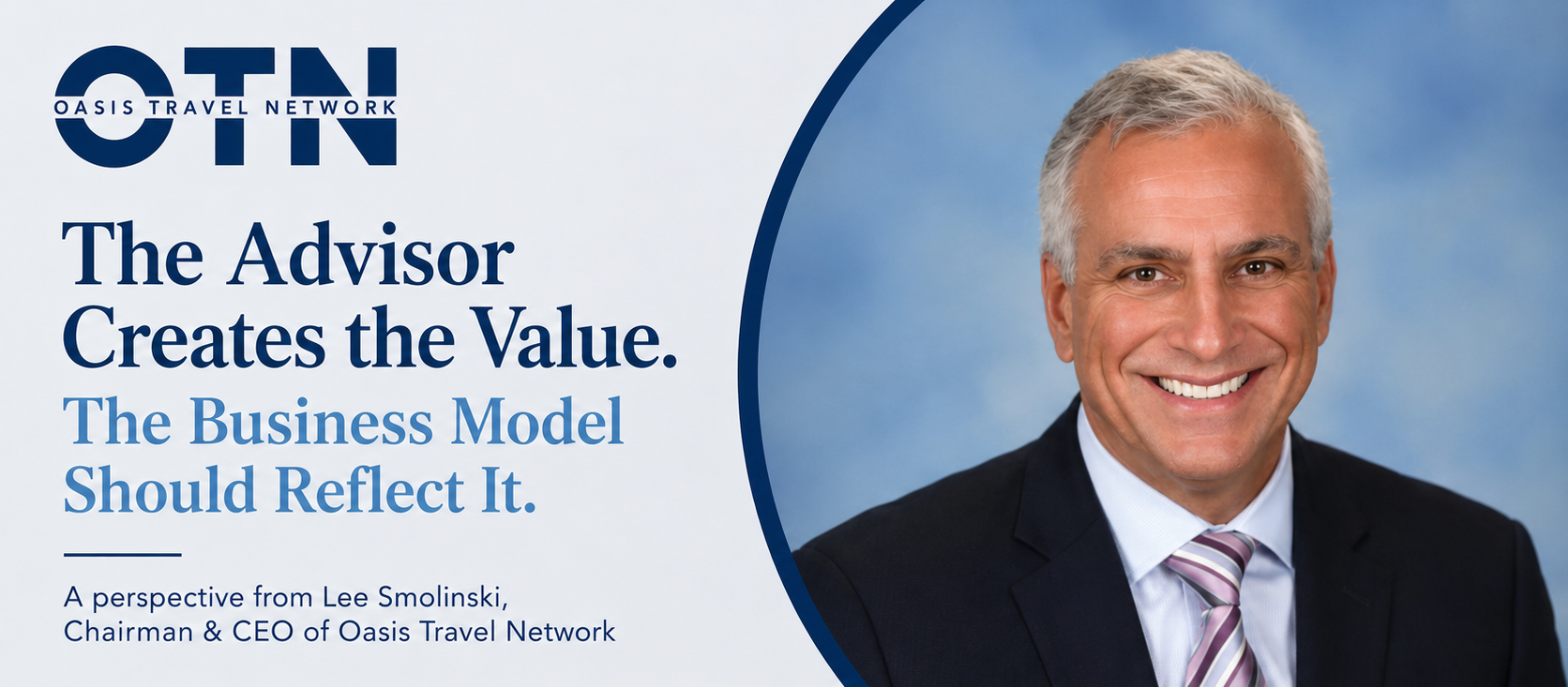
Lee Smolinski
Chairman & CEO
Oasis Travel Network